GCSE
How to revise for GCSE Maths
A step-by-step plan for GCSE Maths revision: find the gaps, practise by topic, work on the calculator and non-calculator papers, and use past papers well.
Arooj Shahid · 24 Oct 2026 · 2 min read
Where to find GCSE Maths past papers, when to start them and how to mark them, so that each paper shows your child exactly what to revise next.
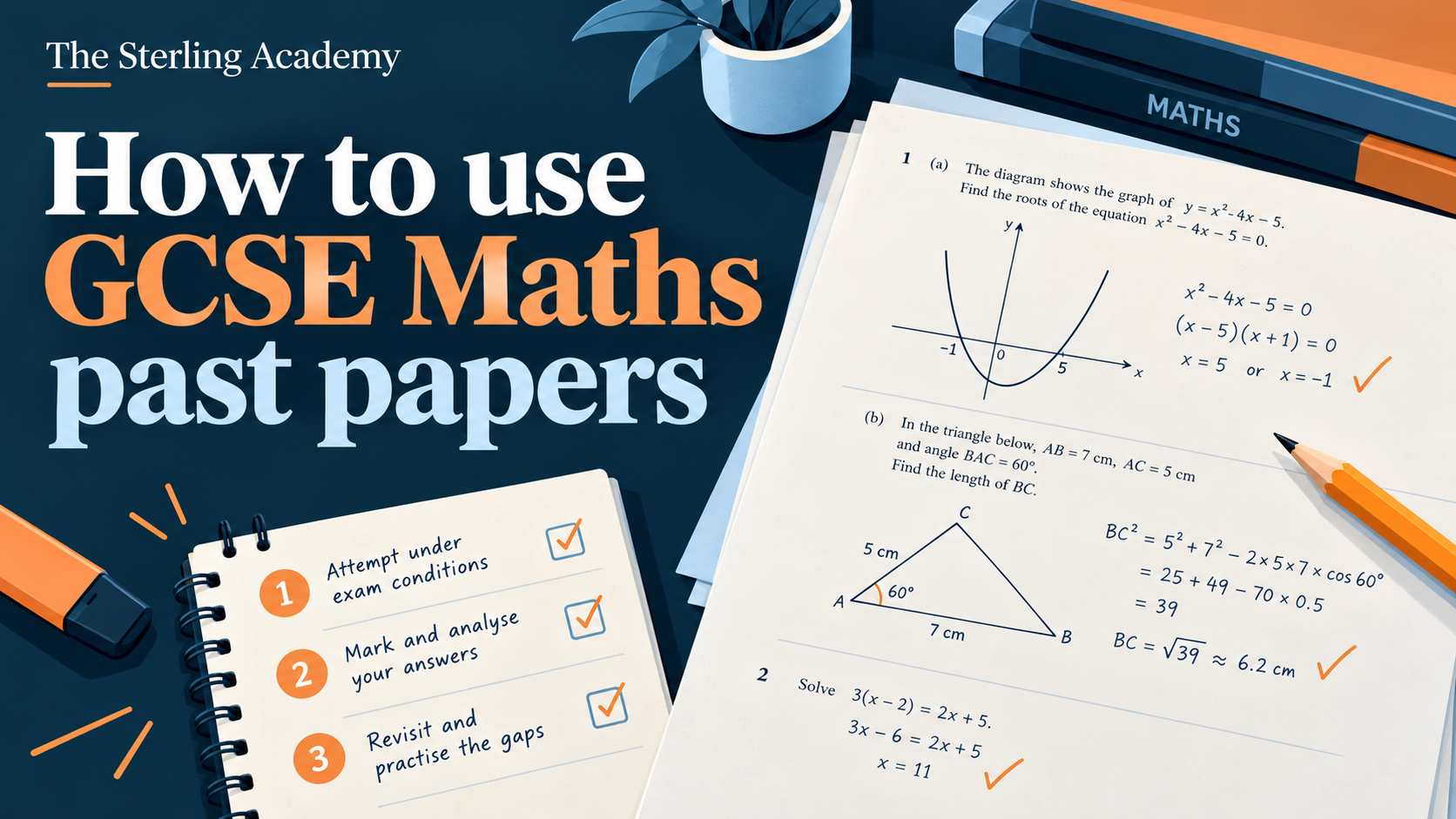
Past papers are the most useful revision tool in GCSE Maths, and many students use them badly. They sit a paper, look at the score and move on to the next one. Used well, a single paper tells your child what to revise for the next two weeks. Here is how to get that out of each one.
The exam boards publish their past papers, mark schemes and examiner reports free on their own websites. Check which board your child's school uses first, because each board's papers have their own style:
AQA (specification 8300)
Pearson Edexcel (1MA1)
OCR (J560)
The newest papers are sometimes kept for schools only for a while, so your child's teacher may be able to share papers you cannot download yet. Practice papers from revision publishers are fine for extra questions, but the board's own papers show the real wording and how the marks are split.
At British-curriculum schools in the UAE and elsewhere outside the UK, many students take the International GCSE instead, from Cambridge (0580) or Pearson Edexcel (4MA1). Everything below works the same way with those boards' papers, although the number and length of the papers are different.
GCSE Maths is three papers of 1 hour 30 minutes each. One is non-calculator and two allow a calculator. There are two tiers: Foundation, which covers grades 1 to 5, and Higher, which covers grades 4 to 9. Practise the tier your child is entered for, and always do the non-calculator paper without a calculator.
Past papers are not only for the last month. Through Year 10 and the start of Year 11, use past paper questions one topic at a time, at the end of a revision session on that topic. Move on to full papers once most of the course has been taught, often around the mock exams. One full paper a week is plenty for most students, as long as each one is marked properly.
A paper only tells you something if it is done in exam conditions: timed, in one sitting, with no notes and the phone in another room. If time runs out, draw a line and finish the rest in a different colour. That shows what your child can do in the time and what they can do at all, which are different problems with different fixes.
Mark schemes give marks for method as well as for the answer. A wrong final answer with clear working can still earn most of the marks, and a right answer with no working can earn very little. Marking with the scheme teaches your child which steps to write down. Read the examiner report for the same paper too: it says where students lost the most marks that year.
This is the step most students skip, and it is where the value is. For every lost mark, write one line: the question, the topic and why the mark went. Most lost marks are one of three kinds:
A slip. A number copied wrongly, a sign error, a question misread. The fix is checking work, not more revision.
A gap. The topic is not secure yet. Revise it, then do five more questions on it from other papers.
Time. The question was never reached. Practise the earlier questions for speed.
After three or four papers the log shows a pattern, and that pattern is the revision plan.
The boards publish grade boundaries for each exam series, and they move from year to year. Turning a score into a grade can be encouraging, but treat it as a rough guide only. What the mistakes log says matters more than the grade.
In recent years students have been given a formulae sheet in the GCSE Maths exams. The arrangement has changed more than once, so ask the school what your child will have in their exam year, and practise with the same sheet.
Our teachers tutor GCSE Maths and International GCSE Maths one-to-one and online, for families in the UK, the UAE and the US. The first class is free.
Want help with GCSE Mathematics? The first class is free.
A step-by-step plan for GCSE Maths revision: find the gaps, practise by topic, work on the calculator and non-calculator papers, and use past papers well.
Arooj Shahid · 24 Oct 2026 · 2 min read
How to revise GCSE Physics: learn the equations and units, set out calculations the same way each time, prepare for the practicals and use past papers well.
Arooj Shahid · 26 Oct 2026 · 4 min read

Simple reading comprehension strategies to use at home, from previewing a book to finding evidence in the text, and how they match the Common Core standards.
Arooj Shahid · 26 Oct 2026 · 4 min read
Enrollment takes about five minutes. Tell us about your child and the times that work, and we'll book their first class free: no card details, no obligation to continue.