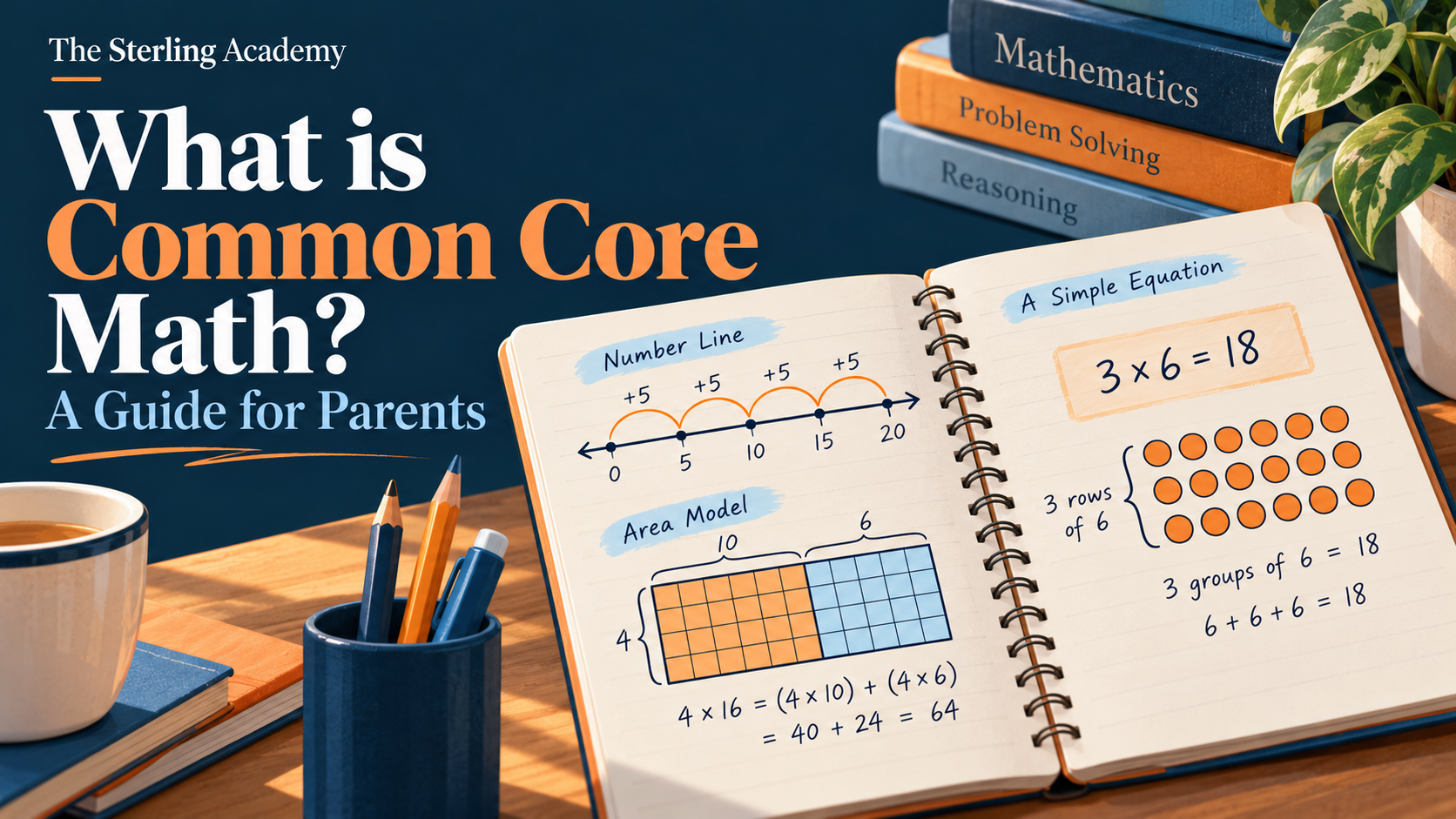
If your child brings home math homework full of number lines, boxes and drawings, and you were taught to line the numbers up and carry, you are not alone. This is Common Core math. Here is what it is, why it looks the way it does, and how you can help without relearning everything.
What Common Core is
The Common Core State Standards are a list of what students should know and be able to do in math and English language arts by the end of each grade, from kindergarten to 12th grade. They were published in 2010 by groups representing the states' governors and education chiefs, and most states adopted them in the years that followed.
The standards set the goals, not the lessons. Your child's school or district chooses the curriculum, the textbooks and the teaching methods. That is why two schools that both follow Common Core can send home quite different worksheets.
Is Common Core still used?
Yes, in many states, though not always under that name. Several states have since revised their standards or renamed them, and a few have replaced them. Even so, many state math standards today are still built on Common Core, and many American-curriculum schools in the UAE follow Common Core standards too. Your state department of education's website shows the standards your child's school follows.
What is different about the math
Common Core asks children to understand why a method works, not only to follow the steps. In the early grades they learn several ways to solve a problem, see how numbers can be broken apart and put back together, and explain their thinking in words or pictures. The aim is number sense: being able to tell whether an answer is reasonable and to work flexibly with numbers.
It also covers fewer topics in each grade, in more depth. Roughly:
Kindergarten to 2nd grade: counting, place value, and addition and subtraction.
3rd to 5th grade: multiplication and division, then fractions and decimals.
6th to 8th grade: ratios and proportions, negative numbers, expressions and equations, and a first look at functions.
High school: algebra, functions, geometry, and statistics and probability.
Common Core math examples
Here are three methods you are likely to see on homework:
Making ten (addition). To add 8 + 5, a child splits the 5 into 2 and 3, adds the 2 to the 8 to make 10, then adds the 3: 10 + 3 = 13. Later the same idea gives 38 + 5 = 40 + 3 = 43.
Counting up on a number line (subtraction). To work out 52 − 38, a child starts at 38 and jumps to 40 (2), then to 50 (10), then to 52 (2). The jumps add up to 14, so 52 − 38 = 14.
The area model (multiplication). To work out 23 × 4, a child splits 23 into 20 and 3, multiplies each part by 4 and adds the results: 80 + 12 = 92. Drawn as a rectangle cut into two parts, it shows why multiplication works, and it leads on to multiplying larger numbers and, later, to algebra.
None of this replaces the methods you learned. The standards expect children to be fluent with the standard method, the one where you line up the digits and carry, for addition and subtraction by the end of 4th grade and for multiplication by the end of 5th grade, with long division following in 6th grade. The strategies come first so that the standard method makes sense when it arrives.
Is it the same as "new math"?
Many parents call Common Core "new math", but that name belongs to a different reform from the 1960s. What people usually mean is the change described above: learning several strategies first, and the standard method after.
Explaining their thinking
Many homework questions ask your child to explain how they got an answer, or to show it with a drawing. This comes from the eight Standards for Mathematical Practice, which describe habits such as making sense of a problem, sticking with it and explaining your reasoning. A right answer with no explanation may not get full credit, so encourage your child to say the steps out loud.
How to help at home
Ask before you show. Ask your child to explain the method from class first. Explaining it is good practice for them, and you will learn the approach the teacher expects.
Use the school's resources. Many curriculum publishers and districts post parent guides and example videos for each unit. Ask the teacher where to find them.
Share your method afterward, not instead. Showing the way you learned can help once your child understands the class method. Present it as another way, not the right way.
Keep math facts sharp. Quick recall of addition facts and times tables makes every strategy faster. A few minutes a day with flashcards or a game is enough.
Talk about math in everyday life. Splitting a bill, doubling a recipe or working out a sale price all use the same thinking as the homework.
Tell the teacher when it is not clicking. A short note saying where your child got stuck helps the teacher more than a finished worksheet that was done with a lot of help.
State tests
Every state tests math and reading each year from 3rd to 8th grade, and once in high school. The tests follow the state's own standards, so practice that matches the standards is also practice for the test.
Our teachers tutor Common Core math one-to-one and online, following your child's grade, for families in the US, the UAE and the UK. The first class is free.